


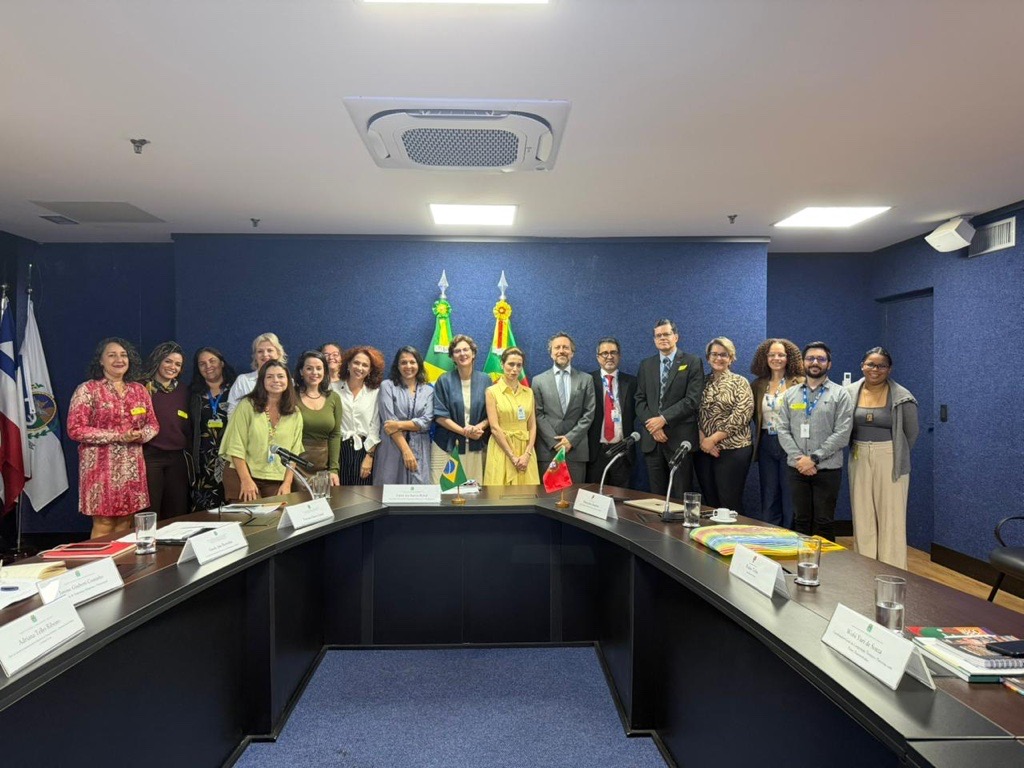
Representatives from the Portuguese government attended a meeting at the Centre of Excellence on 5 May to exchange experiences on public policies regarding adequate and healthy nutrition and the prevention of obesity.
The Portuguese delegation comprised representatives from the country’s Ministry of Health, Inês Tavares Ferreira and Maria João Gregório. The meeting at the Centre of Excellence was also attended by representatives from the Ministry of Development and Social Assistance, Family and Combating Hunger (MDS), the Brazilian Cooperation Agency (ABC) and the Federal District Health Secretariat (SES-DF).
The mission began on 4 May with a meeting at the Ministry of Development and Social Assistance, Family and Combating Hunger (MDS), which coordinated the agenda in partnership with the Portuguese Ministry of Health.
The MDS’s National Secretary for Food and Nutritional Security, Lilian Rahal, highlighted the importance of international cooperation. “The aim goes beyond simply sharing experiences; it is about learning from the concrete realities of each country and transforming this exchange into practical knowledge for the development of public policies,” she said.
At the opening of the activities, the Director of the WFP Centre of Excellence in Brazil, Daniel Balaban, highlighted the importance of the meeting at a time of major global challenges.
“The World Food Programme finds itself in an extremely complex situation: we need to feed around 120 million people every day, whilst available resources are dwindling. This makes cooperation between countries more essential for scaling up sustainable and effective solutions to combat hunger,” he said.
During the meeting at the Centre of Excellence on May 6, results and methodologies applied in South-South cooperation projects were presented, including initiatives focused on school feeding, cooperation on food and nutrition security, and the development of integrated public policies linking local production, nutrition and social protection.
Eliene Sousa, a nutritionist at the Centre of Excellence, highlighted the results of the Nurture the Future project, in partnership with ABC and the Ministries of Health of Brazil, Colombia and Peru, which published a document on the multiple burdens of malnutrition; and presented InovaSAN, a joint project with ABC and MDS, which includes a laboratory that identifies innovative initiatives in policies to promote healthy and adequate nutrition.
The Food and Nutrition Surveillance System (SISVAN), a tool developed by the Ministry of Health that monitors the nutritional status and dietary intake of the Brazilian population, was also presented by Carolina Rebelo Gama, from the Federal District Health Secretariat, as a tool that supports public policy planning by identifying nutritional risks (such as obesity and malnutrition), particularly in primary care.
The mission concluded on 8 May with a visit by the delegation to a health centre in Brasília.