


On 18 November, representatives from the Peruvian government and the World Food Programme (WFP) took part in the second session of the virtual study visit dedicated to the exchange of experiences regarding school feeding programmes in Brazil and Peru.
Organised by the WFP Centre of Excellence against Hunger in Brazil, with support from the National Fund for Educational Development (FNDE) and the Brazilian Cooperation Agency (ABC), the event continued the exchange that began on 11 November.
Unlike the first meeting, which focused on presenting the school feeding programmes of both countries, the second session was more technical, participatory and interactive in nature. The programme was structured around the interests and issues identified by the Peruvian delegation, allowing for an in-depth examination of aspects of Brazil’s National School Feeding Programme (PNAE) and a discussion of experiences that could contribute to strengthening Peru’s School Feeding Programme (PAE).
Experts from the FNDE presented two components of the PNAE considered relevant to the exchange. Edenilza de Souza Carvalho, Monitoring and Evaluation Co-ordinator, addressed the monitoring and evaluation of the Brazilian programme, whilst Daniel Bandoni, Food and Nutritional Security Co-ordinator, presented issues relating to food quality and safety.
Following the presentations, the agenda included 30 minutes for a question-and-answer session, as well as a specific slot to discuss opportunities for cooperation.
The meeting brought together a large Peruvian delegation, comprising representatives from various departments within the Ministry of Development and Social Inclusion and the School Feeding Programme, as well as WFP staff in Peru. The diversity of the sectors represented enabled the discussion to cover different aspects of the implementation of school feeding policies and facilitated direct exchanges between experts from both countries.
Sergio Ríos, Executive Director of Peru’s School Feeding Programme, commented that Peru is moving forward with a process of decentralising public governance. “Sectors such as education and health already operate on a decentralised basis, and we believe that school feeding should also follow this path. We therefore face the challenge of learning how to implement this model, strengthening the capacities of the different levels of government and ensuring the quality and continuity of the programme throughout the country,” he said.
According to Daniel Bandoni, Coordinator of Food and Nutritional Security for the PNAE at the FNDE, the format of the second session made it possible to transform the knowledge shared at the first meeting into a dialogue more tailored to Peru’s needs.
“In Brazil, we have a system of outsourcing school meals, a topic on which we can engage in dialogue with Peru, particularly with regard to guidance for authorities that opt for this model and the terms of contracts with service providers. We intend to continue exploring the topics addressed in the sessions, such as governance, food safety and quality, as well as links with family farming.”
Peruvian programme
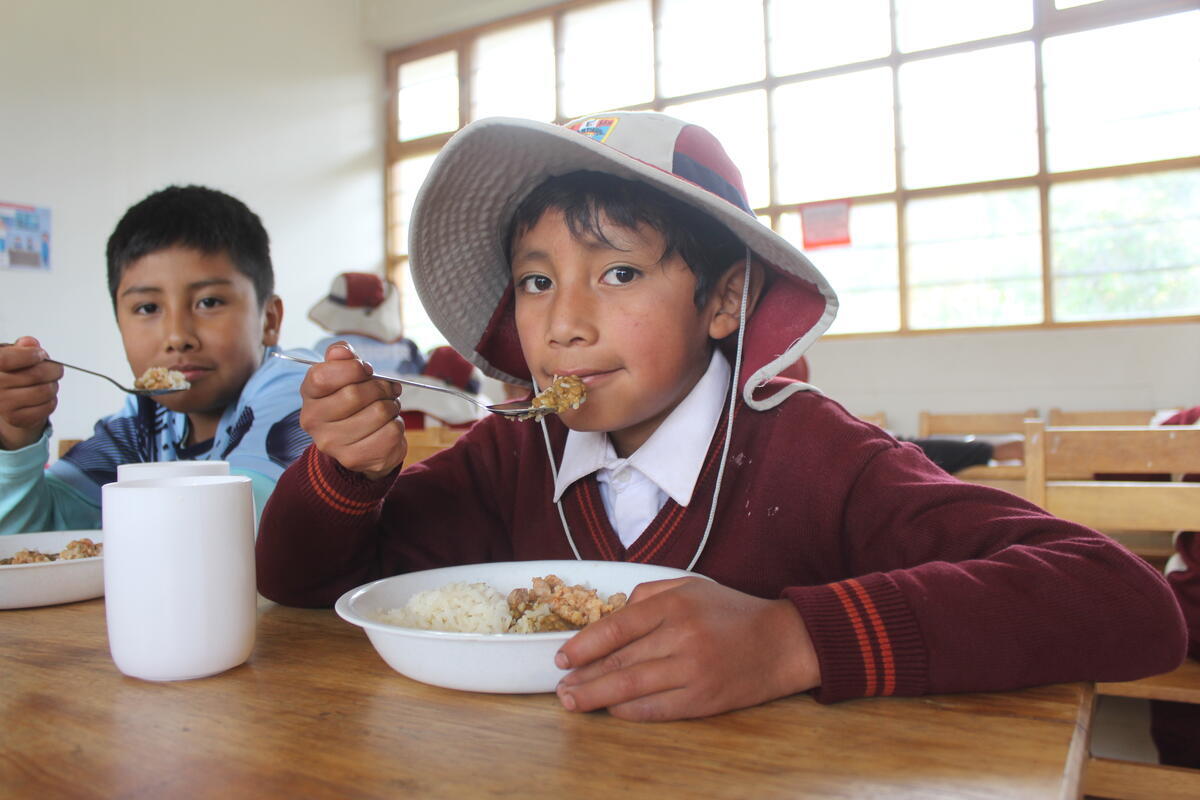
The virtual visit took place at a time when the Peruvian School Meals Programme – established in its current form in 2025 and coordinated by the Ministry of Development and Social Inclusion (MIDIS) – is being strengthened. The programme serves more than 4.1 million pupils in around 67,000 state schools.
Among the priority areas identified by the country are governance, public procurement, coordination with family farming, food quality and social participation.
Virtual study visits
Virtual study visits are a form of cooperation developed by the Centre of Excellence to facilitate the exchange of knowledge between countries without the need for travel.
At no cost to participating countries, the methodology combines content on Brazil’s National School Meals Programme (PNAE) with interactive sessions between representatives and experts from the Brazilian government’s technical departments. The format offers a flexible alternative for technical assistance and allows exchanges to be tailored to the needs and priorities of partner countries.