


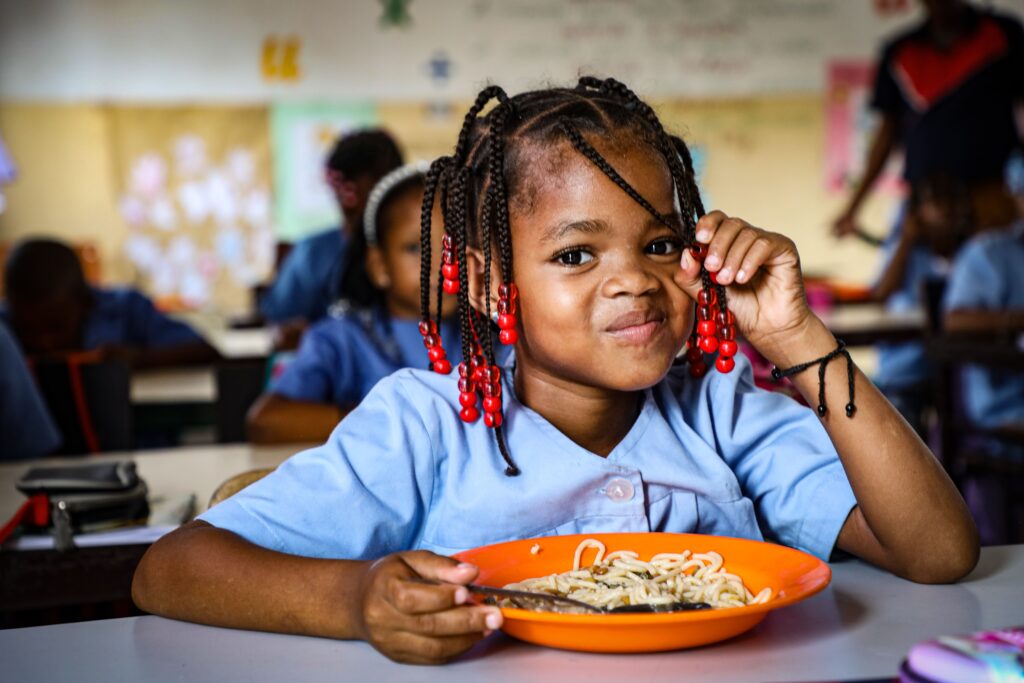
 Botswana hosted the 11th African Day of School Feeding, celebrated on 28 February and 1 March with an event led by the African Union, bringing together governments, the private sector and partners to strengthen and expand school feeding programmes on the continent. This year’s edition highlighted the intersection between school meals, drinking water and hygiene, and positioned school feeding as a multisectoral investment for resilient food systems.
Brazil
Brazil participated as a guest of honour, in recognition of its role in inspiring the creation of the commemorative date and its history of policies that integrate nutrition, education and family farming.
Among the Brazilian authorities participating were Daniel Balaban, director of the WFP Centre of Excellence against Hunger; Brazil’s ambassador to Botswana, João Genésio de Almeida Filho, representing the Brazilian Cooperation Agency (ABC) of the Ministry of Foreign Affairs; and Fernanda Pacobahyba, president of the National Fund for Education Development (FNDE), who participated remotely.
In his speech, Daniel Balaban recalled that the Centre of Excellence was created to promote public policies to combat hunger through technical cooperation. ‘For us at the Centre of Excellence, it is fantastic to see that African authorities are gathered here to reiterate their commitment to adopting school feeding programmes in their countries.’
Ambassador João Genésio de Almeida Filho highlighted the importance of cooperation between countries in his speech.
FNDE President Fernanda Pacobahyba stated in a video shown during the event that this celebration takes us back to 2016, when the heads of state of the African Union reinforced their commitments to food and nutrition education policies. ‘Since then, we have observed that the connection between school feeding, education and family farming has strengthened in several African countries,’ she said.
Expansion
The agenda emphasised evidence of the recent expansion of school feeding in Africa and the continent’s leading role within the School Feeding Coalition, whose largest regional bloc is African.
The meeting noted that, in two years, Africa was the region that most expanded school feeding programmes, with an increase of more than 30% in the number of children served (from 66 million to 87 million).
At the end of the event, organisers and participants emphasised that the integration of local agriculture, education, and water and sanitation services has consolidated school feeding as a strategic policy for human development, social protection, and economic revitalisation in the territories.