


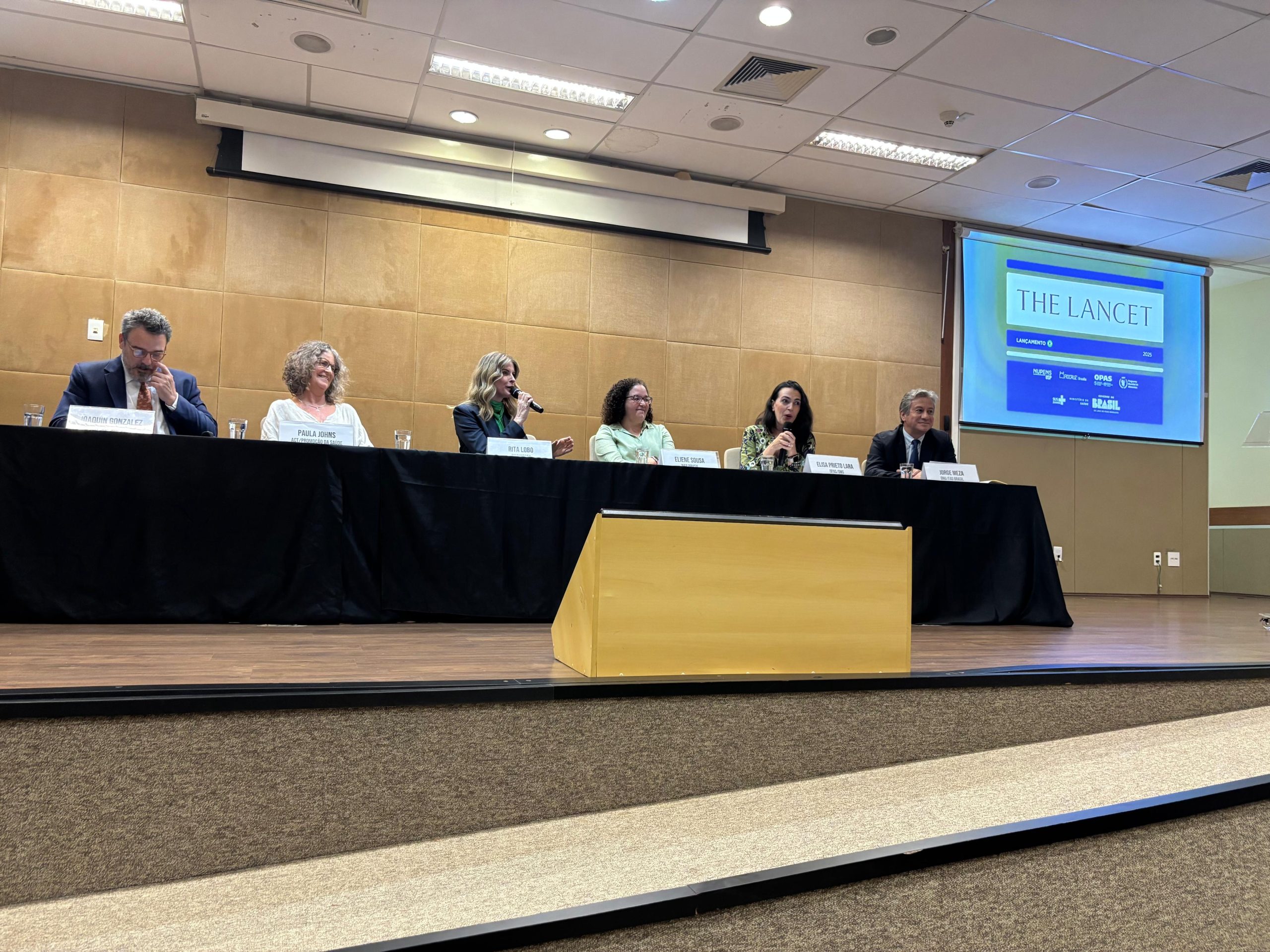
On December 3, Brasilia hosted the national launch of The Lancet Series – Ultra-Processed Foods and Human Health. The event, held in the Fiocruz auditorium, featured scientific presentations of the three articles in the series, led by Carlos Monteiro and Patricia Jaime, both from the Center for Epidemiological Research in Nutrition and Health (Nupens) at USP, and Phillip Baker from the University of Sydney. Chef and high-level supporter of the WFP in Brazil, Rita Lobo, opened the debate and moderated the panel on Public Policies in Latin America.
“I have been working with Nupens for over 10 years, and I started participating in medical and scientific events where cooking was rarely discussed before. I am here to value the kitchen as a space for everyone in the house, where cooking can be a task for everyone to eat real food, without ultra-processed foods,” said Rita Lobo.
Articles
During the presentation of the articles in The Lancet, Professor Carlos Monteiro highlighted that the consumption of ultra-processed foods is directly associated with an increase in chronic diseases, which poses a threat to public health, and spoke about the new classification, which indicates the proportion of ultra-processed foods in the composition.
“We now have ultra-processing markers that show the inclusion of substances that are exclusively for industrial use in food, and that no one has in their kitchen, which helps in identifying ultra-processed foods,” he explained.
He mentioned that one of the tactics of the ultra-processed food industry is strong marketing to create a new eating pattern and convince people to replace real food, which is healthy, with ultra-processed foods full of chemical additives.
“It is an industry that convinces people that drinking soda is better than drinking water, eating ‘strawberry-flavored’ yogurt is better than natural yogurt with fresh fruit, eating nuggets is better than eating chicken,” he explained.
Patricia Jaime reinforced the need for robust policies to address the expansion of ultra-processed foods. “Regulating the production, advertising, and consumption of ultra-processed foods is a matter of public health. In addition, it is necessary to connect the issue of food production to the environmental agenda, with sustainable use of resources,” she said.
Phillip Baker highlighted the leading role played by Brazilian public policies that prioritize food security, such as the National School Feeding Program, and brought a global perspective to the problem, demonstrating how large corporations seek to produce all of people’s food, from breakfast to dinner. For him, the challenge is to build coordinated action between countries, confronting corporate power and promoting healthy food systems on a global scale.
Debate
During the debate, Eliene Sousa, Project Coordinator and Nutritionist at the WFP Center of Excellence against Hunger in Brazil, highlighted the experiences that Brazil promotes through South-South cooperation in exchanges to strengthen food and nutrition security policies and promote sustainable food systems in partner countries.
The debate highlighted that international organizations, civil society, and governments must work together in efforts to combat the spread of ultra-processed foods. Eliene Sousa mentioned that the WFP, the world’s largest humanitarian agency, which distributes food in emergencies, has already included in its “Planning for nutritionally adequate general food assistance guidance notes”, from October 2025, a recommendation against distributing ultra-processed foods, warning that they increase the risk of obesity and a variety of chronic diseases affecting physical and mental health.
The event also featured speeches by Adriano Massuda, Executive Secretary of the Ministry of Health; Patrícia Gentil, representative of the Ministry of Social Development and Fight against Hunger; Paula Johns, from ACT Health Promotion; as well as Elisa Prieto Lara, from PAHO/WHO; Jorge Meza, from FAO; and Joaquin Gonzalez-Aleman, from Unicef.
The Peruvian Ministry of Health, represented by the specialist from the Health Promotion Department, Beatriz Quispe Quille, also participated, with an online speech at the event.
Scientific journal
The British medical journal The Lancet is considered a benchmark for medical diagnoses and opinions worldwide.
The event was organized by Nupens/USP, the Oswaldo Cruz Foundation – Fiocruz Brasília, the Pan American Health Organization/World Health Organization (PAHO/WHO), the United Nations World Food Programme (WFP) Centre of Excellence against Hunger in Brazil, and the Brazilian Ministry of Health.
The full launch in Portuguese, English, and Spanish can be viewed on the @WFPBrasil YouTube channel, which also broadcast the event live.