


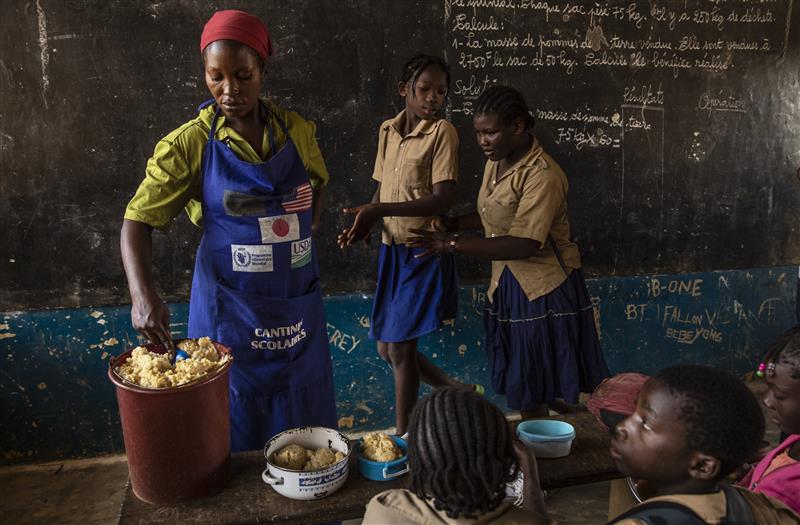
On 25 March, a video was released presenting the results of the Seeds for Tomorrow project, a South-South cooperation initiative which, between 2024 and 2025, supported 10 schools and 10 agricultural cooperatives in the Republic of Congo, and carried out activities in collaboration with officials from the country’s Ministries of Education and Agriculture.
The project provided inputs to strengthen family farming and launched a strategy to use local produce in school meals, contributing to more dynamic food markets and to students’ food security.
Seeds for Tomorrow was implemented through a multilateral partnership involving the Government of Brazil, via the Brazilian Cooperation Agency (ABC), the National Fund for Educational Development (FNDE) and the Ministry of Agrarian Development; the Government of the Republic of the Congo; the World Food Programme in the country; the World Food Programme in Rome; the WFP Centre of Excellence against Hunger in Brazil; and the United Nations Office for South-South Cooperation (UNOSSC). Funding was provided by the IBSA Fund (India, Brazil and South Africa).
Manuals
In addition to the video, English versions of the four technical manuals developed under the project to support school feeding and family farming in the Congo have been launched.
These materials share successful experiences from Brazil with a view to helping develop strategies to strengthen institutions and promote policies that improve small-scale farmers’ access to local markets.
The manuals are: “Brazilian Agricultural Policies” (green), which provides a strategic overview of public policies aimed at family farming; “Stages of Purchasing Products from Family Farmers for the PNAE” (yellow), an operational guide to the procurement process for school meals; “Monitoring and Evaluation of the National School Feeding Programme” (blue), which offers tools for monitoring the performance of school feeding programmes; and “Social Oversight of the School Feeding Programme in Brazil” (brown), which explains the role of school feeding committees and highlights the importance of community participation.
The video is also available on the social media channels of the Centre of Excellence, ABC and UNOSSC (in English). The manuals, also available in Portuguese and French, can be accessed on the Seeds for Tomorrow Project page on the Centre of Excellence website.