


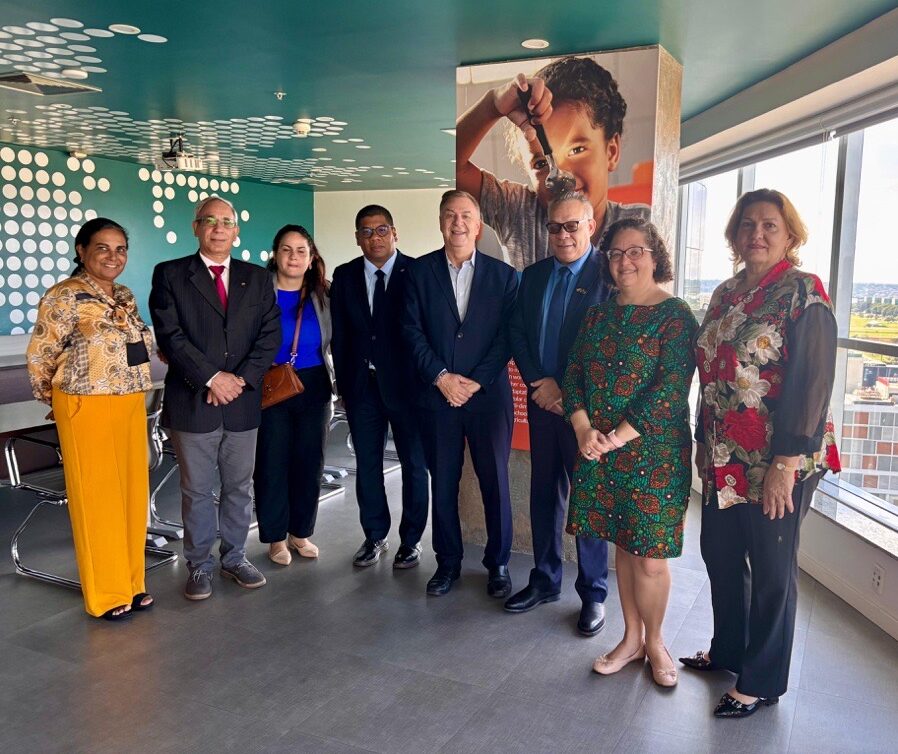
The WFP Centre of Excellence against Hunger in Brazil received a visit from representatives of the Cuban government on 10 March to discuss possibilities for cooperation around food and nutrition security.
The director of the Centre of Excellence, Daniel Balaban, nutritionist and project coordinator Eliene Sousa, and partnership officer Albaneide Peixinho welcomed the Cuban representatives.
Minister Jesus Otamendiz Campos, from the Ministry of Labour and Social Security, presented the Cuban government’s Pró-Social project, designed to identify people facing food insecurity, which is an important tool for assisting the most vulnerable population, especially in the current situation of energy blockade in the country.
He also mentioned his intention to strengthen cooperation ties with the World Food Programme office in Cuba to provide direct assistance to those most in need. “We have the capacity for resilience and adaptation, but all solidarity aid is welcome. Above all, we need timely emergency aid to break out of the economic siege caused by the energy blockade we are experiencing,” he said.
Cuba’s ambassador to Brazil, Víctor Manuel, added that this blockade has a severe impact on the population.
The director of the Centre of Excellence, Daniel Balaban, stated that the mandate of the World Food Programme allows us to act as intermediaries for sending food and seeds to the population, an action to be carried out in conjunction with the WFP office in Cuba.
Emergency food items such as rice, beans, powdered milk, canned meat, as well as emergency items such as rechargeable lamps or solar lights, would be the priority, according to Carlos Fidel Martin, Director of the International Economic Organisations Division of the Ministry of Foreign Trade.
The Director of Urban, Suburban and Family Agriculture at the Ministry of Agriculture, Elizabeth Turruellas, highlighted some seeds that would be strategic in minimising food insecurity, such as lettuce, chard, tomatoes and pumpkin.