


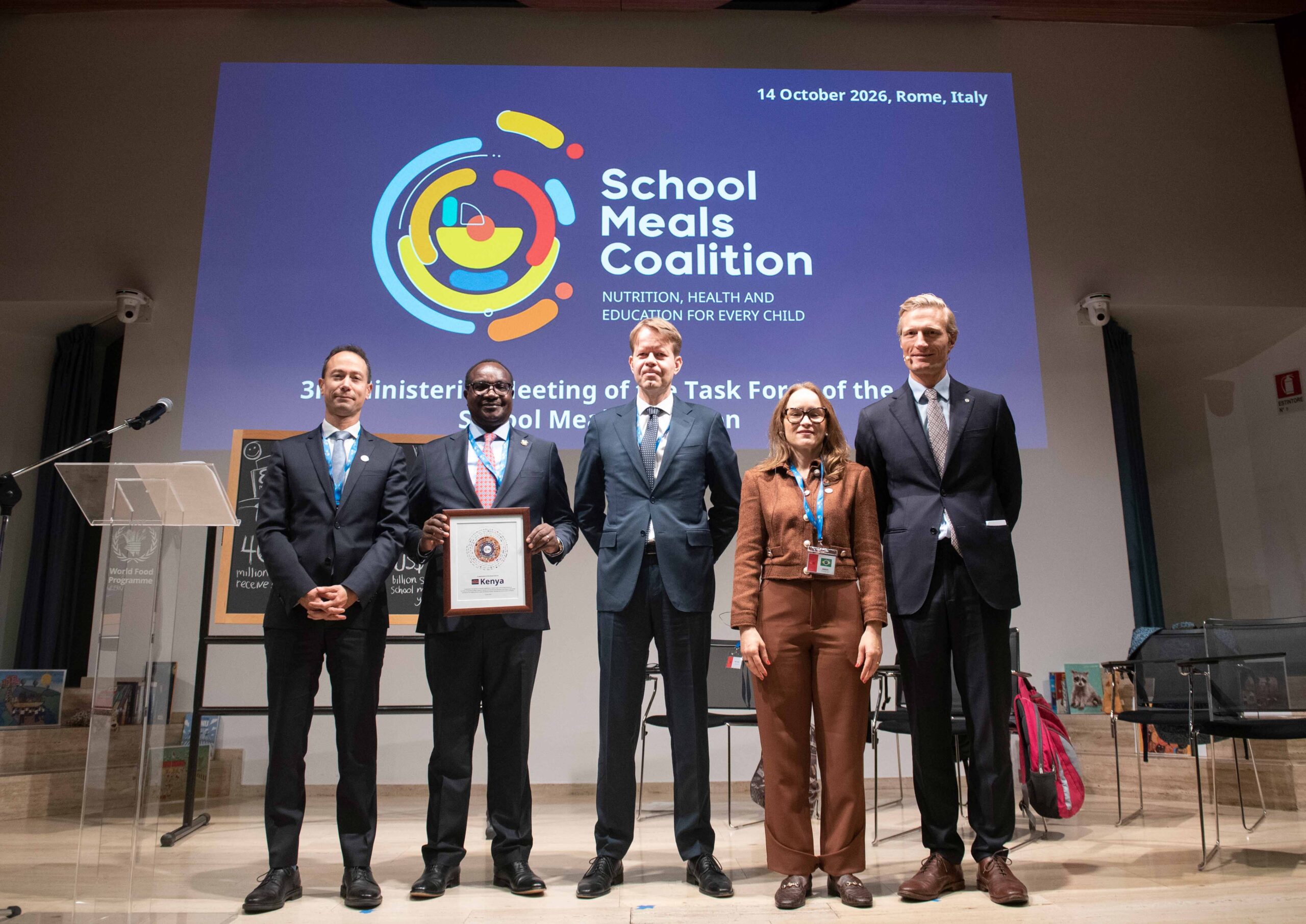
On 13 and 14 October, representatives of the Brazilian government took part in the 3rd Ministerial Task Force Meeting of the School Meals Coalition in Rome, the main governing body of the global initiative aimed at strengthening school feeding programmes. On this occasion, Kenya joined Brazil, France and Finland as co-chairs of the Coalition.
The Brazilian delegation was led by the president of the National Fund for Education Development (FNDE), Fernanda Pacobahyba, accompanied by representatives from the Brazilian Cooperation Agency (ABC) of the Ministry of Foreign Affairs and the WFP Centre of Excellence against Hunger in Brazil.
The meeting brought together representatives from governments, international organisations, civil society and development partners to assess the Coalition’s progress and set priorities for the coming years. Among the topics discussed were sustainable financing, the strengthening of food systems, expanding access to school meals and advocacy strategies to increase political commitment to the issue.
Brazil
During the meeting, Fernanda Pacobahyba spoke about the role of political and social mobilisation in strengthening school feeding programmes and ensuring their sustainability. In her address, the president of the FNDE shared Brazil’s experience in translating political commitment into large-scale public policies, highlighting factors that have helped to establish the National School Feeding Programme as an international benchmark.
The Brazilian delegation emphasised the importance of coordination between different levels of government, sectors and civil society actors to ensure the sustainability of school feeding programmes. The country also shared lessons learnt in building collaborative networks that link education, family farming, nutrition and social protection, helping to ensure that school meals have a positive impact on local development.
Internationally recognised for its track record in this field, Brazil has played a leading role in promoting school feeding as a tool to combat hunger, improve nutrition and strengthen more resilient and sustainable food systems.
Highlights
Several important announcements were made during the meeting. Coverage of school feeding programmes was announced as a new indicator under SDG 4. Brazil proposed strengthening technical support mechanisms for the Coalition’s member countries.
In Kenya, the establishment of a national coalition helped to mobilise partners and resources, transforming investment in school feeding into a collective national effort.
In Senegal, several advances have been made since the creation of a multisectoral group on nutrition and school health. One of the most significant outcomes is the National School Feeding Act, which is currently in the process of being passed by Parliament. The Act establishes common principles, responsibilities and mechanisms for the implementation of school feeding in the country.
Guatemala’s school feeding programme, thanks to its legislation and public funding, is a state policy that is universal, free of charge and based on community participation. “This is essential in a country with so many ethnic communities, languages and local cultures,” said Minister Anabella Giracca Mendez.
The Director of the Global Alliance Against Hunger and Poverty, Renato Godinho, emphasised that coordinating international actions has always been a challenge, but that this “new generation” of initiatives – such as the Global School Feeding Coalition and the Alliance itself – has been developing innovative approaches to mobilising partners and producing concrete results.
Next steps
The meeting resulted in a joint declaration and a document setting out priorities for the next two years, which will be available on the Coalition’s official website. In 2027, the Coalition Summit will take place in Finland.
The School Meals Coalition brings together governments and partners committed to the goal of ensuring that all children have access to nutritious school meals by 2030, whilst promoting education, health and sustainable development. Watch the video here on the Coalition’s recent progress.