


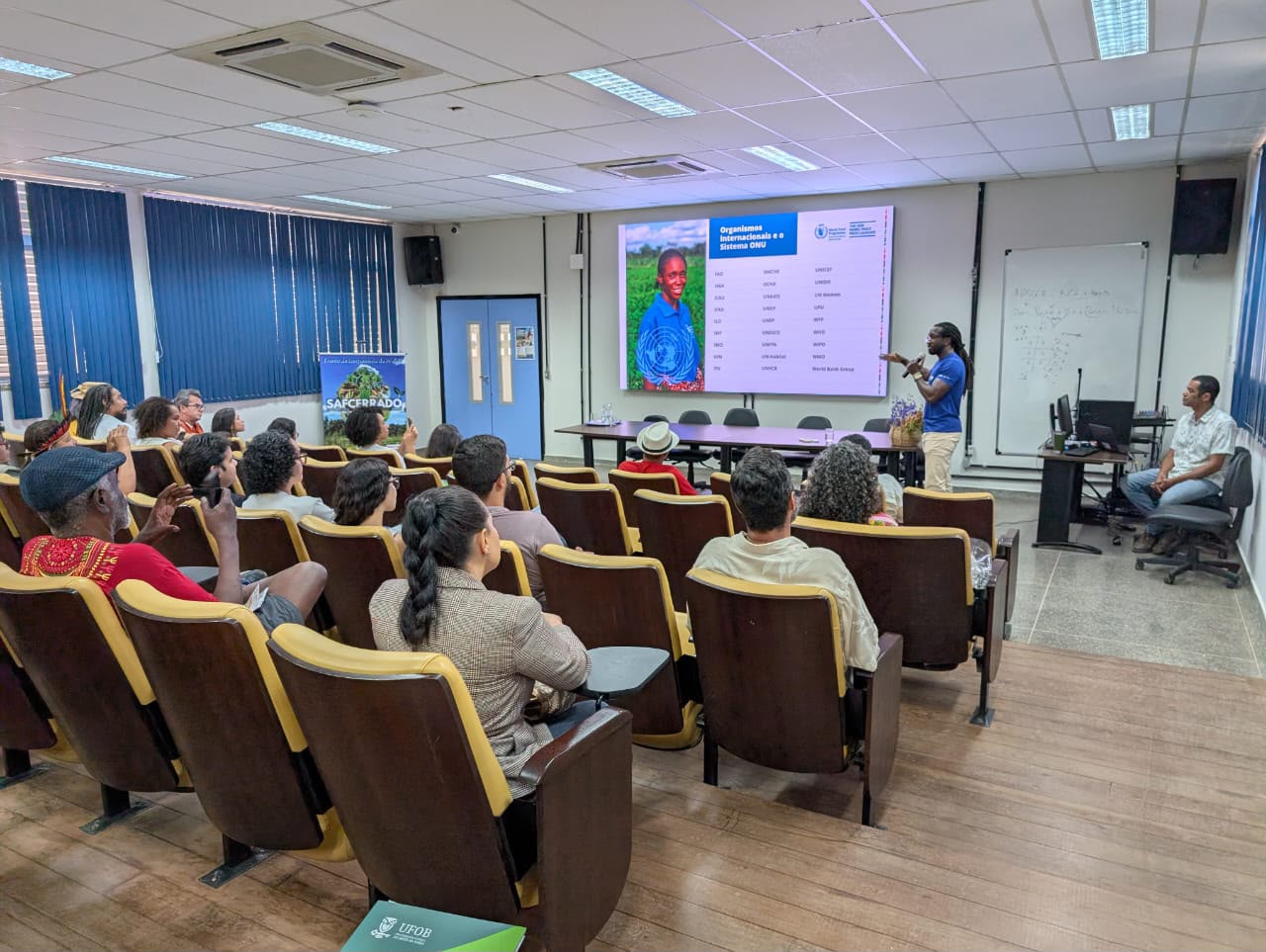
On 26 September, the WFP Centre of Excellence against Hunger in Brazil took part in an event organised by the Federal University of Western Bahia (UFOB) to launch and celebrate applied research and extension projects focused on sustainable rural development and quality of life in rural areas.
The research will be carried out as part of the SAFCERRADO Project – Socio-biodiversity and Solidarity-based Rural Economy – coordinated by Professor Mário Alberto dos Santos, who is responsible for training in syntropic agriculture under the Beyond Cotton Project in Benin.
Representing the Centre of Excellence, Osiyallê Akanni presented the institution’s key findings during the event and highlighted South-South cooperation initiatives, with a focus on the ‘Beyond Cotton’ Project in Benin. Furthermore, she shared with representatives of the cooperatives present how the successful experiences in Benin can support local production in the region.
Implemented by the Centre of Excellence in partnership with the Brazilian Cotton Institute (IBA), the Brazilian Cooperation Agency (ABC), UFOB, the WFP in Benin and the Government of Benin, the Beyond Cotton Project aimed to strengthen the food and nutritional security of cotton-producing households through the diversification of agricultural production.
The project promoted the intercropping of edible crops alongside cotton plantations, helping to increase food availability, boost household incomes and drive the economic development of rural communities.
As part of the project, UFOB organised training sessions and facilitated the exchange of technical knowledge. In this context, Professor Mario Alberto dos Santos played a key role in delivering training sessions for farmers and technicians from Benin.
The training sessions covered agroecological practices aimed at soil restoration, increasing biodiversity, the production of biofertilisers and the integration of different agricultural crops, thereby strengthening the sustainability of local production systems.
During the event, Osiyallê Akanni emphasised the importance of collaboration between universities, governments, international organisations and local communities in developing innovative and sustainable solutions to food security challenges. Furthermore, Osiyallê shared recent images of agroecological farming in Benin, which has been replicated and scaled up by the local community.
He also highlighted that the partnership with UFOB exemplified how the exchange of knowledge between Brazil and African countries can generate tangible impacts for rural development.