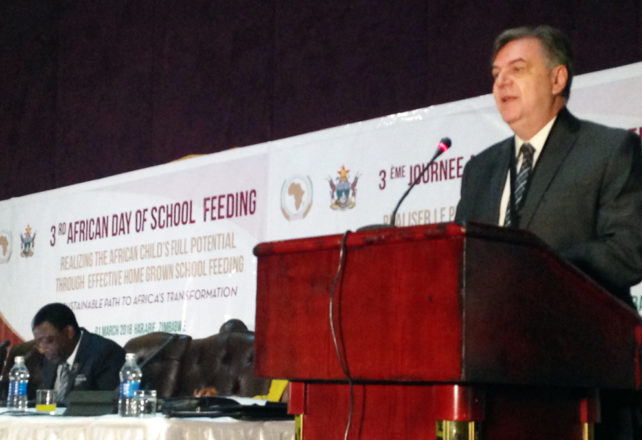

Last week, during the celebration of the 4th African Day of School Feeding on 1st March, African Union Member States approved the official communiqué of the event, with key recommendations to advance home-grown school feeding in the African continent. The official ceremony took place in Abidjan, Côte d’Ivoire, with 320 participants representing multiple sectors and 23 Member States, including 13 ministers and deputy ministers.
The theme of the event was “The Year of Refugees, Returnees and Internally Displaced Persons: Towards Durable Solutions to Forced Displacement in Africa”. The Member States recognized that home-grown school feeding initiatives contribute to the humanitarian-peace-development nexus due to their social protection effects. They are also a crucial tool for African countries to achieve the Agenda 2063, by empowering communities to ensure that all children, specially girls, can access education from early childhood to completion of secondary level.
In the communiqué, participants stressed the importance of the home-grown school feeding approach. School feeding, when relying on home-grown food chains, supports children to have adequate and more nutritious meals and at the same time promotes inclusive growth and rural development. School feeding programmes provide a steady market for smallholder farmers products and boost local economies.
School Feeding Cluster
During the celebrations, the Continental Home-Grown School Feeding Cluster official instruments were launched: Terms of Reference, Strategy, and Reporting Mechanisms. The Cluster’s instruments counted on the coordination role and technical support of the WFP Centre for Excellence in Brazil, WFP Africa Office and WFP Country Office in Côte d’Ivoire. Hard copies were distributed to participants.
A report of the African Union annual survey on the progress of Member States in school feeding was presented. The survey shows a significant increase in the number of children benefiting from school feeding programmes and in the involvement of local communities.
Key messages
The communiqué stresses that the School Feeding Cluster is a useful platform to ensure partnerships and collaboration among all key-stakeholders and to facilitate experience sharing. It is an entry point for all Member States to present their needs for partners and to share and search for information in school feeding programmes. The Cluster will interact with initiatives in the continent, such as the recently created Centre of Excellence against Hunger in Cote d’Ivoire.
The document also highlights the need for more investments in national school feeding programmes and points out that governments and partners need to work together to establish innovative finance mechanisms. The importance of partnerships to keep advancing school feeding in the continent and the role of South-South dialogue and networks in supporting countries to move forward were also emphasised. Participants also made a set of recommendations for Member States (see recommendations below).
Key recommendations
• Member States need to link the School Feeding Cluster strategy with their national strategies to facilitate coordinated continental experience sharing.
• All African governments should be urged to ensure effective implementation of Home-Grown School Feeding in their respective countries. Member States need to work towards allocating significant budgets to school feeding in order to strengthen national ownership and control.
• Member states are encouraged to provide feedback to the annual surveys and submit reports on the progress of implementation of Home-Grown School Feeding at the country level. Which will be taken to the heads of state summit. A report will be produced annually by the cluster.
• Considerable emphasis should be given to communication and advocacy, highlighting the huge importance of Home-Grown School Feeding programmes.
• Continental and regional initiatives and platforms should be created and sustained for sharing experiences and peer learning.
• Strengthen involvement of multiple partners in national HGSF Programmes, including key UN Agencies such as UNESCO, UNICEF, WFP and FAO, as well as Civil Society, Community-Based Organisations and Private Sector.
• The African Union Commission is requested to follow-up on the implementation of the recommendations in this and the previous Communiqués, in consultation with the key Development Partners and through the School Feeding Cluster.
Download the Communiqué in English
Download the Communiqué in French


The fourth edition of the African Day of School Feeding was celebrated in Abidjan under the theme “Investing in home-grown school feeding for achieving Zero Hunger and sustaining inclusive education for all, including refugees, returnees and internally-displaced persons in Africa”. The event was opened by His Excellency Daniel Kablan Duncan, Vice President of the Republic of Côte d’Ivoire, and celebrated under his distinguished patronage. Around 200 representatives of governments, civil society, and UN agencies participated in the event, including 14 ministers and deputy ministers.

The African Day of School Feeding is celebrated every 1st March. The date was instituted in January 2016 by African Union Heads of State and Government in recognition of the immense value of home-grown school feeding. This specific model of school feeding links local agricultural production to food procurement for schools, with direct benefits for smallholder farmers and for school-attending children.
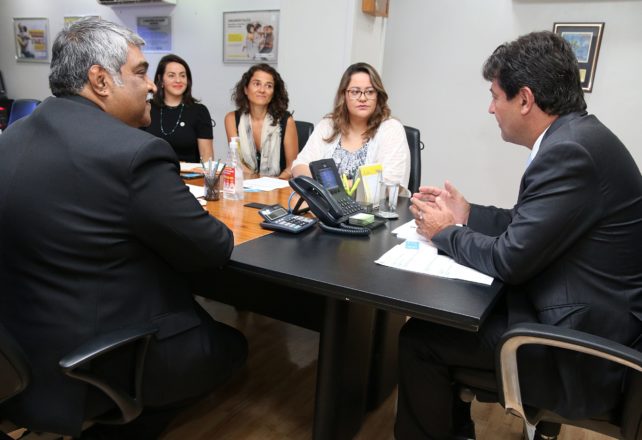
The date was created after a delegation of the African Union made a study visit to Brazil to see first-hand the Brazilian home-grown school feeding approach and to discuss the terms of collaboration of the WFP Centre of Excellence with the African Union. The African Day of School Feeding marks the commitment of African countries to promoting homegrown school feeding programmes as a key strategy to achieve the Sustainable Development Goals. The first edition of this celebration took place in Niamey, Niger, while the second and third editions were respectively organized in Congo and Zimbabwe in 2017 and 2018.

The event
Activities marking this year’s celebration kicked off on 27 February. A group of experts held a meeting to discuss the highlights of the School Feeding Cluster Strategy and Work Plan. Both documents were elaborated with technical support from the WFP Centre of Excellence.

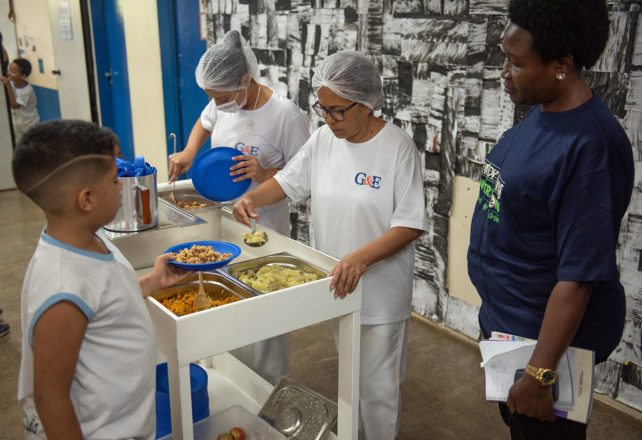
On 28 February participants undertook a field visit to N’Zikro, Aboisso, a community in the skirts of Abidjan. The delegation visited the farm of a group of farmers who give part of their production including bananas, cassava and corn, to school canteens in their village. They also visited a group of women transforming cassava into “Attieke” and providing hot meals to children in schools. After meeting the farmers, the delegation visited a school canteen in N’Zikro to see the children that benefit from the food they produce.
The event spanned three days, with the celebrations culminating on 1st March. It was attended by H.E. Prof. Sarah Anyang Agbor, Commissioner for Human Resources, Science and Technology of the African Union and H.E. Daniel Kablan Duncan, Vice President of the Republic of Côte d’Ivoire who highlighted this event with his presence, thereby demonstrating the commitment of the Government of Côte d’Ivoire to implement and sustain school canteens and school feeding programmes. The event was also graced by senior government representatives from African governments, African Union Commission Staff, development partners and members of the diplomatic corps.

School feeding in Africa
The Government of Côte d’Ivoire made Education a priority and as such demonstrates its commitment through the implementation of a school canteen programme aiming to increase schooling rates in primary school but also give more chances to children from poor households to pursue their studies, thereby reducing failures and drop outs.
“The commitment from these 14 ministers to make sure African children are getting the meals and support they need to thrive in school is extraordinary. I know that what is happening on this African Day of School Feeding will make a real difference in the lives of boys and girls throughout the continent. I look forward to working with the African Union and these country leaders to make sure school feeding programmes can be as effective as possible in helping African children reach their full potential,” said David Beasley, Executive Director of the UN World Food Programme WFP.
“In recent years, we have witnessed school feeding shifting from social protection programmes to a core feature of many countries’ strategies to ensure food and nutrition security for all,” said Daniel Balaban, director of the WFP Centre of Excellence against Hunger in Brazil. “School feeding has become a key intervention for countries to achieve Sustainable Development Goal 2, and the African Union has been a great advocate for the adoption of home-grown school feeding as a continental strategy to improve nutrition, increase smallholder farming and eliminate hunger”.
African nations continue to prioritise school feeding through policy and legislation, to improve retention, attendance and the performance of children in schools as well as creating economic growth. Across the continent, 39 countries have school feeding programmes managed and financed by governments; 21 of them have homegrown school feeding programmes. Ghana, Malawi, Kenya and Zimbabwe all feed over 1 million. South Africa and Nigeria each feed more than 9 million children every day of the school year.


“The efficient work in finance ensures the proper management of resources, which is fundamental increase the reach of the work that we carry out in the field. In this way, as a key piece of a gear, I feel that I am contributing to the work of the World Food Programme and to achieving the Sustainable Development Goals”. This is how Luis Felipe Sandrini defines his satisfaction in working as finance assistant at the WFP Centre of Excellence against Hunger.
Luis Felipe is 36 years old and has made his career in the private sector. Almost two years ago, he left Sao Paulo in search of a new life in Brasília, in the WFP office. He is an economist by choice and accountant by profession requirement and began his professional career as a trainee at one of the largest auditing and consulting firms in the world. In the three years he was in the company, he reached the position of senior auditor. With the experience accumulated in external audit, he decided to ‘move to the other side of the table’ and started working as international financial planning officer in a large construction company. He took advantage of the segment expansion in Brazil to propel his professional growth.
The construction industry in Brazil experienced an intense crisis, and in early 2017, as part of the company’s restructuring plan, the company reduced drastically the number of employees. After seven years working there, Luis Felipe found himself without work for the first time. He had married a few months before. “I decided to take this time to devote myself to personal projects that I had been putting off for some time, like photography, while keeping aware for job opportunities. In that process, I made the decision to seek a job that would bring me a personal purpose, besides the professional.”
“I once read that United Nations officials are ‘agents of change’, and I immediately identified myself with it,” says Luis Felipe. He then began to monitor the UN Brasil website in search of job opportunities in the area of finance. When he saw the opening at the WFP Centre of Excellence, he talked to Sheila, his wife, about the possibility of moving to Brasilia, and she was supportive. “It was the only vacancy outside of São Paulo to which I applied,” he says.
“I was very well received by my colleagues and found an environment of highly qualified people in the most diverse areas,” says Luis Felipe. “I feel satisfied with why we do our work every day. It’s a different job than I had in private enterprises. The success metrics of a company are different from those of an international organization such as the WFP Centre of Excellence. Our success is measured by the wider reach of people in the different countries where we operate.”
Working at the UN has been a rewarding experience for the economist. For him, two words gained new meanings after this experience: dialogue and cooperation. “Dialogue among different social actors such as governments, the private sector, educational institutions and NGOs to understand local demands and find joint solutions for more equitable development. And cooperation between the public and private sector for the mobilization of resources for humanitarian causes.”
“The UN was created in the post-war period to promote international cooperation, maintain security and world peace. I see the changing global demands, and the UN stands as the global forum for member countries to discuss and reach consensus on how to deal with them.”
According to Luis Felipe, the UN is in a constant process of renewal and, with this, it manages to innovate to meet the existing demands and anticipate the future ones. “In the financial arena, for example, we see the use of new technologies to access and assist people in the most remote places and give them autonomy so that they can make their own choices. This is the case with WFP’s cash-based transfer programmes, which allow beneficiaries to choose to buy locally the food of their choice. To get an idea of the reach of this programme, in 2018, $ 1.7 billion was transferred to 62 countries.”
“The UN is a place for dialogue and representation of all, including groups that commonly have little voice in their social contexts,” says Luis Felipe. In the case of Brazil, he sees that the various UN agencies operating in the country help to include issues related to the Sustainable Development Goals in the country’s public policy discussions. “In exchange, I see that Brazil can contribute significantly to the UN and other countries, mainly through sharing the successful public policies that we have here that can inspire other countries.”

The Beyond Cotton initiative completed its planning phase with the four participating countries, Benin, Kenya, Mozambique, and Tanzania. A team of experts was in Kenya and Tanzania from 4 to 15 February to share with local stakeholders the initiative’s strategy and to validate the main implementation aspects with both countries. A similar validation process was made in Benin and Mozambique in December. The Beyond Cotton team will now prepare country-specific projects that will establish the priorities of the initiative and guide its implementation in each country.
The Beyond Cotton project is a joint initiative of the WFP Centre of Excellence against Hunger and the Brazilian Cooperation Agency, with support from the Brazilian Cotton Institute. It aims to support smallholder cotton producers and public institutions in the four countries to connect cotton by-products, such as oil and cake, and associated crops, such as corn, sorghum and beans, to reliable markets, including school feeding programmes. The Beyond Cotton initiative will contribute to generate income for the smallholder farmers and to increase food and nutrition security in rural areas.

In many cotton-producing countries, the main challenge is to find steady markets for cotton by-products and associated food crops. There is usually an assured, growing market for the cotton fibre, but selling the remaining oil and cake and the associated crops that are commonly grown in rotation with the cotton may be difficult.
The profit generated by the commercialization of the cotton fibre is not enough to maintain the family, and the demand for sustainable cotton fibre remains unmet, due to the lack of interest of smallholder farmers to invest in this production system. By better structuring the value chain of cotton by-products and associated products, the Beyond Cotton initiative will increase income and improve the food and nutrition security status of rural families, increase agricultural production and link it to school feeding programmes, and create incentives for more smallholder farmers to invest in sustainable cotton production.

Kenya
Cotton in Kenya is mainly grown by smallholder farmers in arid areas. It is estimated that cotton production provides livelihood to 27,000 farmers, which is why cotton has been identified as a key sector for the government’s policy to address poverty, known as “Kenya Vision 2030”.
During the one-week mission, the Beyond Cotton team established contacts between national public and private institutions, directly or indirectly linked to the Kenyan cotton sector. They also identified priorities for the cotton value chain in Kenya and elaborated and shared with local stakeholders the strategic axes of the country project. Another goal of the mission was to set the mechanisms for coordination and technical implementation of the initiative, the next steps and the responsibilities of the actors involved.

Tanzania
In Tanzania, the technical mission discussed with national players how to integrate the Beyond Cotton initiative to other cotton production projects in a complementary way and with the local school feeding programme and nutrition policies. They informed local stakeholders about the Beyond Cotton initiative and its methodology and worked jointly to establish a set of priorities for the initiative’s strategy in the country.
The Beyond Cotton team established contacts among local institutions linked to the cotton sector, both from the public and the private sectors. They discussed with the main actors the strategic axes of the country project and the coordination mechanisms for the implementation of the initiative, the next steps and the responsibilities of each actor involved.