


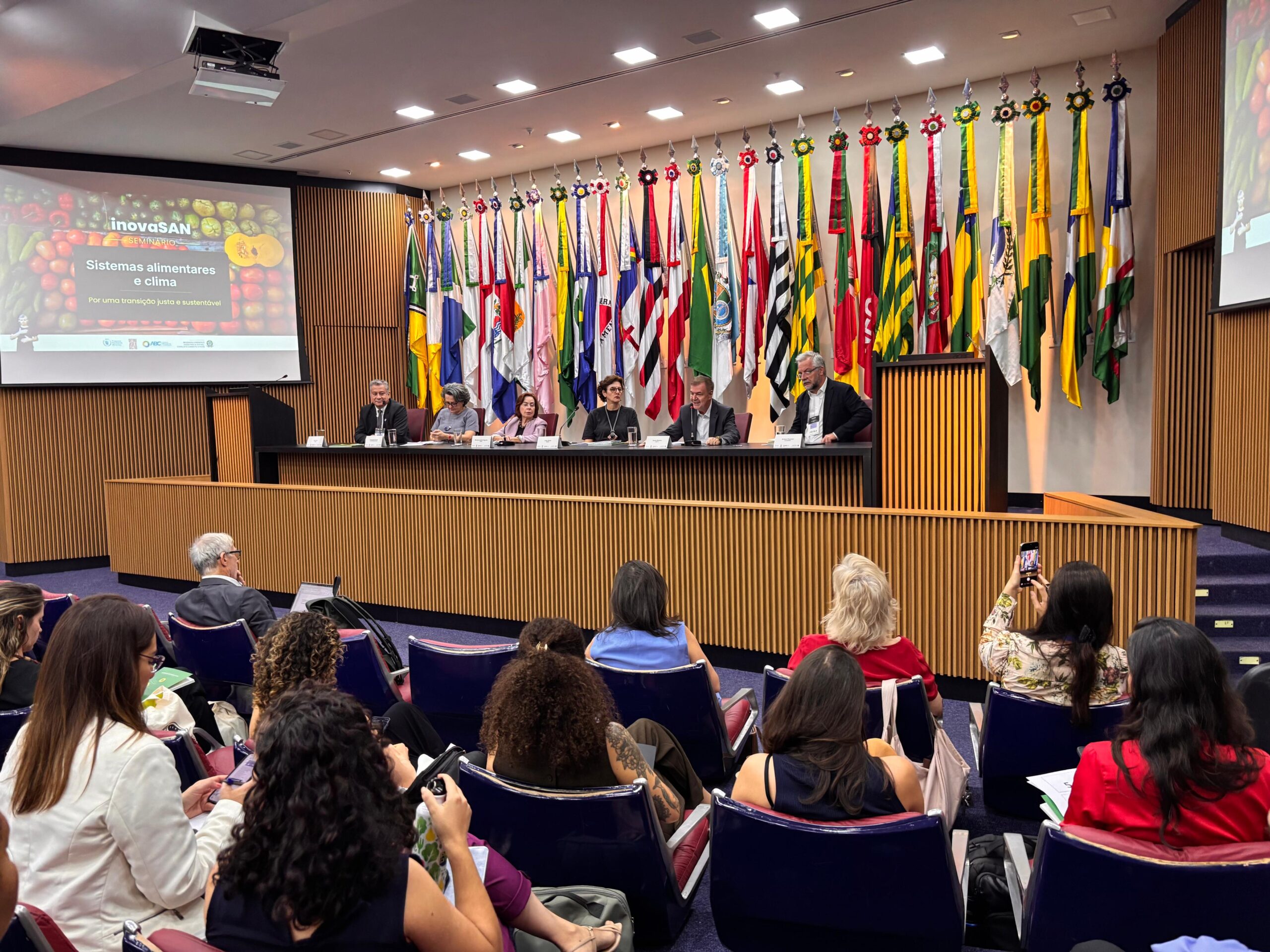
Experts, representatives from the federal government, international organisations and civil society took part in the international seminar “Food Systems and Climate: towards a just and sustainable transition”, held in Brasília on 24 August by the Josué de Castro Chair in Healthy and Sustainable Food Systems at USP.
The event (available on the Centre of Excellence’s YouTube channel) took place as part of the InovaSAN project, implemented by the WFP’s Centre of Excellence against Hunger in Brazil, in partnership with the Ministry of Development and Social Assistance, Family and the Fight against Hunger (MDS) and the Brazilian Cooperation Agency (ABC).
The meeting brought together researchers and public sector managers to discuss how food systems can simultaneously contribute to combat hunger, promoting food and nutritional security, and tackling climate change.
Food systems
Food systems encompass all stages related to food, from production, processing, transport and marketing to consumption and disposal. During the seminar, participants emphasised that transforming these systems is essential to making food production and access to food healthier, more inclusive, more resilient and more environmentally sustainable.
The transition involves integrated public policies, strengthening family farming, reducing inequalities, enhancing the value of local areas and expanding cooperation between different sectors of society.
Seminar
The opening of the event was attended by officials including the National Secretary for Food and Nutritional Security at the Ministry of Social Development (MDS), Lilian Rahal; the Chief of Staff at ABC, Andréia Rigueira; the Director of the WFP Centre of Excellence against Hunger in Brazil, Daniel Balaban; the holder of the Josué de Castro Chair, Arilson Favareto; the FAO Representative in Brazil, Jorge Mesa; and the Chair of the National Council for Food and Nutritional Security (Consea), Elisabetta Recine.
In opening the seminar, Daniel Balaban highlighted the importance of strengthening food systems adapted to local realities. “School feeding programmes demonstrate that it is possible to build more sustainable food systems when countries prioritise the purchase of locally produced food, respect local dietary habits and strengthen local farmers, economies and communities. This is a strategy that drives development, promotes food security and enhances resilience in the face of climate challenges,” he said.
Arilson Favareto emphasised that the climate agenda and the food agenda must go hand in hand. “Science has shown that it will not be possible to tackle the climate crisis without bringing about profound changes in the way we produce, distribute and consume food.
“The transition of food systems must be fair, taking into account social inequalities and the varying capacities of different regions to implement change,” she said.
Panel 1
The scientific panel was chaired by Favareto and brought together researcher Inês Rugani Ribeiro de Castro, from UERJ, Professor Aline Martins de Carvalho, from USP, and Professor Ricardo Abramovay, an international authority on sustainability and food systems.
The experts discussed gaps in scientific knowledge, monitoring mechanisms and the role of public policy in accelerating changes capable of reducing environmental impacts without compromising food security.
During the debates, Ricardo Abramovay highlighted the need to move beyond models of production and consumption that concentrate environmental and social risks. “The transformation of food systems requires diversification of production, the valuing of biodiversity and incentives capable of aligning economic objectives with the planet’s ecological limits. It is not just a matter of producing more food, but of producing better and with greater social justice,” he stated.
Panel 2
The second panel brought together representatives from various federal government bodies to discuss the implementation of public policies focusing on the relationship between food systems and climate.
Participants included, amongst others, Lilian Rahal, representing the Ministry of Social Development (MDS); Aloísio Melo, from the Ministry of the Environment and Climate Change; Camila Alves Rodrigues, from the Ministry of Agrarian Development; and the president of CONSEA, Elisabetta Recine. The discussions covered topics such as family farming, food security, climate plans and strategies to strengthen the role of local authorities.
For Lilian Rahal, the development of integrated public policies is essential to tackling current challenges. “Guaranteeing the human right to adequate food necessarily involves building sustainable food systems. We need to align the agendas for food security, social development, agriculture, the environment and climate so that the responses are effective and reach the most vulnerable populations,” she emphasised.
Representing civil society, Elisabetta Recine emphasised the importance of social participation in the transformation process. “A just transition of food systems depends on ongoing dialogue between governments, academia, producers and civil society. The collective development of public policies is fundamental to ensuring that solutions are inclusive, democratic and sustainable,” she stated.
Courses
In addition to the discussions, the seminar marked the official launch of three courses on Food Systems and Climate, organised in partnership with the Josué de Castro Chair, the MDS and ABC, as part of the inovaSAN Project. All courses will be available on the Capacita MDS platform from September 2026.
The first course, open to the general public and available in Portuguese with English and Spanish subtitles, will present the fundamentals of the relationship between food systems and climate, as well as the main challenges and pathways towards a just and sustainable transition.
The second course is aimed at municipal managers and technical staff involved in the ‘Alimenta Cidades’ Strategy. The training will take place live, with fortnightly sessions combining theoretical content, guided activities and the exchange of experiences to support the development of local strategies for the transition of food systems.
Registration will open on 31 August 2026 on the websites of the Centre of Excellence against Hunger and Capacita MDS.
An international course entitled ‘International mobilisation to increase convergence and coherence between food systems and climate agendas’ will also be offered, aimed at international public sector managers, international organisations and civil society organisations.
The initiative will seek to strengthen the exchange of experiences, challenges and strategies to increase convergence between climate and food agendas in different countries.
Public policies
The initiative was developed based on the understanding that transforming food systems requires building capacity, bringing different sectors together, and translating knowledge into public policy and concrete action.
According to Gisele Bortolini, general coordinator for the Promotion of Healthy Eating at the Ministry of Social Development (MDS) and coordinator of inovaSAN, the courses will contribute both to deepening understanding of the relationship between food systems and climate and to supporting the formulation of public policies, as well as to strengthening international cooperation and broadening global commitments to building more sustainable food systems at every stage, from production to consumption.