


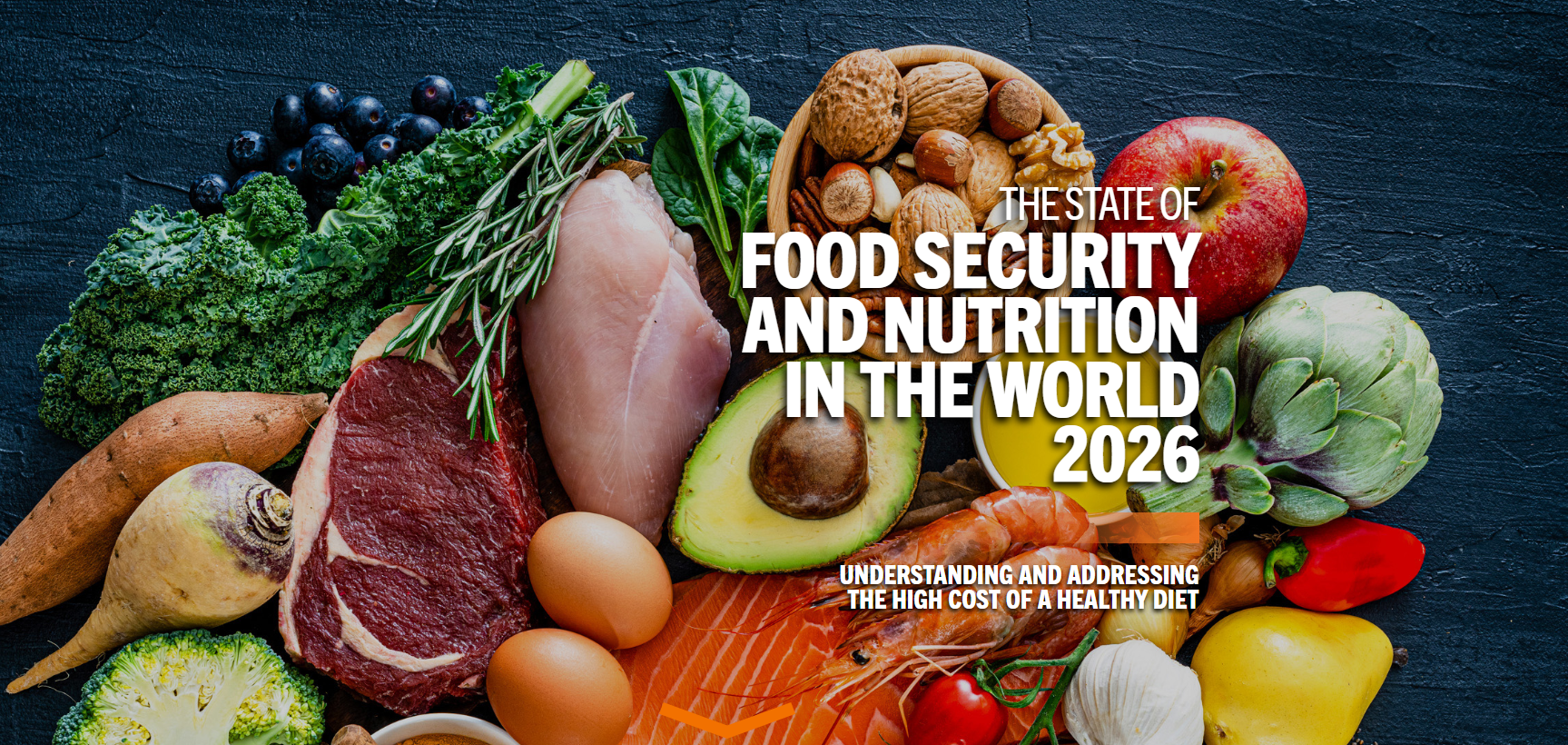
 Rome, 21 July 2026 – Global hunger fell for the third consecutive year in 2025, showing that progress is possible. However, the improvements remain fragile, unevenly distributed and insufficient to achieve the Sustainable Development Goals by 2030, according to the report “The State of Food and Nutrition Security in the World” (SOFI 2026), published on Tuesday (21) by five specialised agencies of the United Nations. Access it here.
The report estimates that 7.8 per cent of the world’s population suffered from hunger in 2025, down from 8.1 per cent in 2024 and 8.6 per cent in 2022, confirming a steady, albeit slow, improvement. According to these figures, around 645 million people suffered from hunger in 2025, representing a reduction of almost 14 million compared with 2024 and 43 million compared with 2022.
Despite global progress, the recovery remains uneven across regions. Asia, Latin America and the Caribbean have all shown steady improvements in recent years. In contrast, Africa is currently home to around 309 million people suffering from hunger, compared with 292 million in Asia. Whilst the upward trend observed in Africa in previous years is beginning to stabilise – with the proportion of the population suffering from hunger falling from 20.3 per cent in 2024 to 20.0 per cent in 2025 – the continent now has the highest absolute number of hungry people, against a backdrop of rapid population growth.
Broader measures of food access paint a similar picture. It is estimated that 25.8 per cent of the world’s population (around 2.1 billion people) were living in a state of moderate or severe food insecurity by 2025, meaning that these people had to consume food of lower quality or in smaller quantities. This figure represents a fall from 27.1 per cent in 2024 and 28.7 per cent in 2020 – nearly 86 million fewer people than in 2024 and 135 million fewer than in 2020 – although it remains above pre-pandemic levels.
Regional disparities remain very marked. In 2025, more than half of the African population (56.6 per cent) was experiencing moderate or severe food insecurity, compared with 22.9 per cent in Latin America and the Caribbean, 8.7 per cent in North America and Europe, and 20.3 per cent in Asia. Food insecurity also remains higher in rural areas than in peri-urban and urban areas, whilst women continue to be disproportionately affected, although the gender gap narrowed slightly in 2025.
Hunger forecasts in the context of the conflict in the Middle East
The annual report also presents updated hunger forecasts for the next five years, in light of the conflict in the Middle East. Depending on the duration of the crisis’s impact on food price inflation – driven by rising energy and fertiliser prices – between 510 and 520 million people may still suffer from hunger in 2030 (compared with a projection of 503 million in the pre-conflict scenario), although the global number of undernourished people is projected to fall by 20 per cent. However, these projections do not take into account other potentially destabilising factors, including the effects of extreme weather events, such as El Niño in 2026 and 2027, which could further exacerbate this situation.
The report’s co-authors – the Food and Agriculture Organisation of the United Nations (FAO), the International Fund for Agricultural Development (IFAD), the World Health Organisation (WHO), the World Food Programme (WFP) and the United Nations Children’s Fund (UNICEF) – warn that the 2026 conflict in the Middle East, coupled with extreme weather events and reductions in official development assistance and humanitarian funding, threatens to undermine the progress made towards ending global hunger.
Slow progress
The report highlights that global progress on maternal and child nutrition remains insufficient to meet international commitments, including the 2030 nutrition targets.
Indicators such as child stunting, wasting, overweight, low birth weight and exclusive breastfeeding show only minor improvements, and progress is too slow to meet the targets. At the same time, anaemia among women aged 15 to 49 is worsening, whilst the prevalence of obesity in adults is rising steadily – from 12.1 per cent in 2012 to 16.2 per cent in 2024 – in contrast to the target of halting its rise by 2025. Only 30.8 per cent of children aged 6 to 23 months worldwide have a minimally varied diet, and 150 million children under the age of five still suffer from severe stunting.
Progress again varies significantly from region to region. The prevalence of child stunting is falling in Africa and is on track to meet the 2030 target in Asia, whilst exclusive breastfeeding rates are improving in all regions for which data are available. However, almost all regions are facing growing inequalities in the treatment of anaemia among women, and childhood overweight is rising rapidly in Oceania.
The cost of a healthy diet
This year’s SOFI report provides an in-depth analysis of the cost of a healthy diet: the average minimum expenditure required to purchase locally available food that meets energy and nutritional requirements. According to the FAO and the WHO, a healthy diet is one that is adequate, balanced, varied and moderate.
The report highlights that costs remain a major constraint to achieving Sustainable Development Goal 2 (Zero Hunger), although reducing costs alone is not sufficient to improve diet quality and nutritional outcomes.
In 2025, the average cost of a healthy diet worldwide rose to $4.28 in purchasing power parity (PPP) per person per day, up from $3.44 PPP in 2021 and $2.94 in 2017. Latin America and the Caribbean recorded the highest cost ($4.91 PPP). At the same time, the number of people worldwide who cannot afford a healthy diet fell from 2.97 billion (37.4 per cent of the world’s population) in 2021 to 2.69 billion (32.7 per cent) in 2025.
However, this trend masks striking disparities between regions. In Africa, access to a healthy diet has deteriorated significantly: by 2025, 66.6 per cent of the population could not afford it, a percentage that is more than double that of Asia, Latin America and the Caribbean.
The costs of a healthy diet vary considerably from region to region due to structural differences in agri-food systems. Animal-sourced foods, fruit and vegetables account for the largest share of the total cost, whilst starchy staple foods contribute relatively little. Animal-sourced foods are the biggest factor in the cost of a healthy diet in Africa, whilst vegetables account for the largest share in Latin America and the Caribbean.
Food value chains play a decisive role in price formation. Post-production activities account for 70–75 per cent of what consumers pay, and up to 40 per cent of the total cost relates to processing, logistics and wholesale. It is therefore essential to improve efficiency in these sectors, particularly to reduce the cost of perishable and nutrient-rich foods.
Reducing the cost of a healthy diet requires specific, context-appropriate policies that expand the supply of nutritious food whilst reducing structural costs across all agri-food value chains. This includes investment in infrastructure, research and development, irrigation and cold chains, as well as reforms to subsidies, trade facilitation and regulatory frameworks.
Targeted interventions that boost productivity, reduce losses and promote sustainable practices can, at the same time, improve nutritional outcomes, strengthen resilience and contribute to climate targets.
The report argues that the work ahead between now and 2030 is immense. However, a world in which healthy diets are already within reach for almost one in three people is a world worth fighting for.
A word from the representatives
Mr QU Dongyu, Director-General of the FAO: “The report shows that progress is possible, but we need to move faster. Ending hunger and making healthy diets accessible requires political commitment, sustained investment and policies that facilitate this. Recent crises – from natural disasters such as the coronavirus disease (COVID-19) pandemic to man-made disasters such as flashpoints, the war in Ukraine, the crisis in Gaza and the recent disruption to shipping in the Strait of Hormuz – have highlighted both the resilience of agri-food systems and the need to strengthen them further to better serve the world’s most vulnerable people, farmers and consumers.”
Mr Álvaro Lario, President of IFAD: “The SOFI report shows that the cost of a healthy diet continues to rise, and that nearly 2.7 billion people still cannot afford healthy food. Resilient value chains must be at the heart of the solution. Our task now is to turn the data provided by the SOFI report into investments, and to do so through partnerships. Together, we can create value chains, market systems and rural economies that make healthy food accessible to all.”Ms Catherine Russell, Executive Director of UNICEF: “Every child deserves the opportunity to grow and develop to their full potential, and this begins with access to a nutritious and affordable diet. This report is a stark reminder that food systems are failing millions of children and families. Food, health, education and social protection must go hand in hand to protect the most vulnerable children and women in the face of global crises.”
Mr Carl Skau, Acting Executive Director of the WFP: “Behind every figure in this report is a family struggling to make ends meet to pay for food. Conflicts and climate-related disruptions are forcing these families to live increasingly beyond their means. We must continue to work with partner agencies, governments and communities to build food systems that are resilient to shocks, so that families can afford nutritious food even in times of crisis. What is needed now is sustained investment that matches the scale of the challenge.”
Dr Tedros Adhanom Ghebreyesus, Director-General of the WHO: “Whilst we welcome the clear progress we have made in reducing hunger, healthy diets remain out of reach for one in three people on the planet. Obesity continues to rise and progress on maternal and child nutrition is stagnating. Yet we know what works: policies that make healthy food the easiest choice, encouraging breastfeeding, packaging labelling, taxing unhealthy products and protecting children from harmful advertising. Healthy diets are not a luxury: they are the foundation of health and must be available to everyone.”
Press Office
FAO (+39) 06 570 53625
[email protected]
Nicholas Rigillo – FAO
FAO Press Office
[email protected]
Alberto Trillo Barca – IFAD
+39 366 576 3706
[email protected]
Nadia Samie-Jacobs – UNICEF
Communications Officer (Press)
[email protected]
Jordan Cox – WFP (Rome)
[email protected]
Jin Ni – WHO
Communications team
[email protected]