


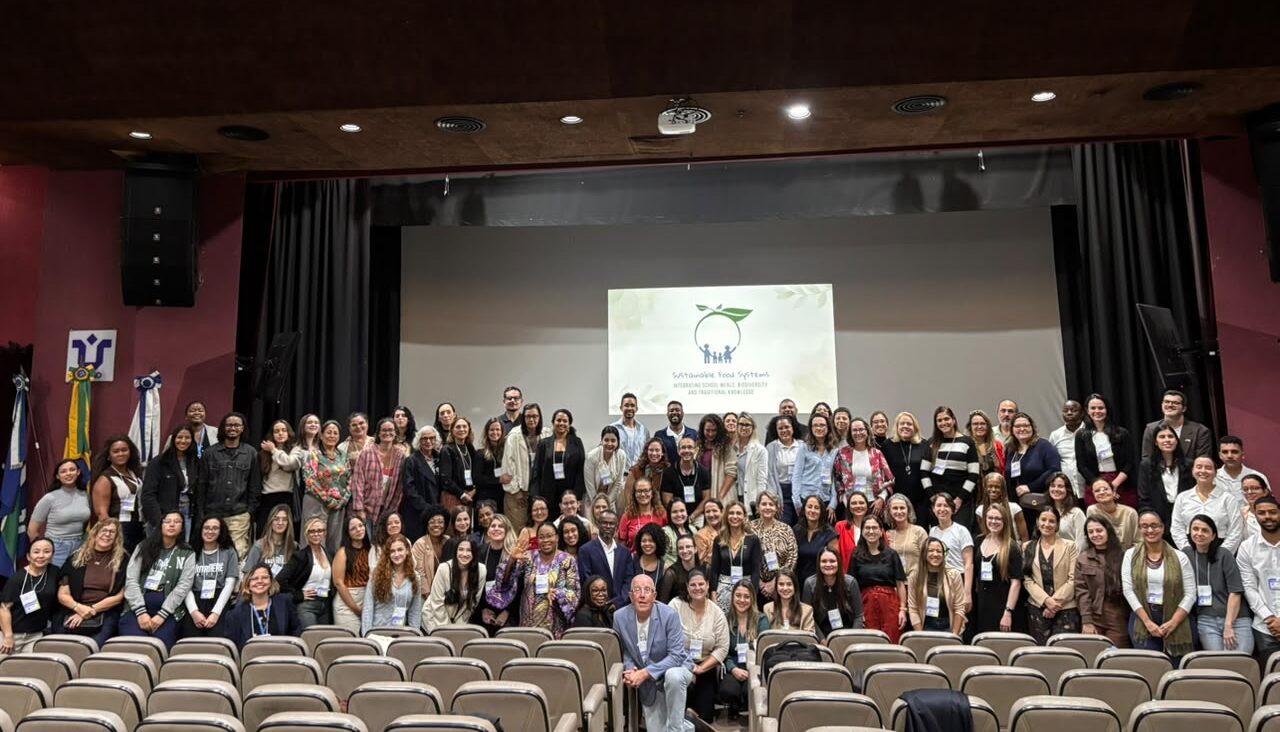
Increasing the consumption of fish in schools was one of the key themes of the Technical Workshop on Sustainable Food Systems: Integrating School Meals, Biodiversity and Traditional Knowledge, held in Rio de Janeiro on 23 and 24 September.
Organised by the WFP Centre of Excellence against Hunger in Brazil, the National Fund for Educational Development (FNDE) and the Brazilian Cooperation Agency (ABC), the event formed part of the programme for the 3rd International Meeting on School Meals, Innovation and Sustainability, hosted by the Federal University of the State of Rio de Janeiro (UNIRIO).
The meeting brought together representatives from governments, international organisations, nutrition students and academics, and civil society organisations to discuss the role of school meals in promoting sustainable, inclusive and resilient food systems.
The inclusion of fish in school meals was highlighted for its nutritional value and its potential to strengthen small-scale fisheries and local economies. In 2026, the FNDE designated the ‘Year of Fish in School Meals in Brazil’, reinforcing the importance of this agenda.
The workshop also highlighted the importance of South-South cooperation in the exchange of knowledge and experiences between countries. Representatives from Mozambique, Congo, Ethiopia and Peru were present and shared initiatives relating to school feeding, sustainability and the strengthening of local production.
“It is this cross-cutting nature of school feeding that has made it a topic for international cooperation and diplomacy. Today, the World Food Programme is one of the leading actors in the field of school feeding worldwide and has extensive experience in supporting school feeding programmes,” said Saulo Ceolin, head of the General Coordination for Food and Nutritional Security at the Ministry of Foreign Affairs.
For Paola Barbieri, a project analyst at ABC, South-South Cooperation is a key element in linking successful experiences, such as the Brazilian model, and supporting the development of solutions tailored to the common challenges faced by other countries in the Global South.
According to Livia Martins, a nutritionist in the Programmes department of the Centre of Excellence, “school feeding is a powerful tool for linking nutrition, education, sustainability and local development. The exchange of experiences that took place during the event demonstrated the potential of this agenda to promote healthier and more resilient food systems”.
The event also featured bilateral meetings with the participating countries and a workshop in which participants were presented with case studies addressing the themes of sustainability, food systems and school meals, to be discussed and explored in greater depth.