


Between 8 and 25 September, a mission from the WFP Centre of Excellence against Hunger in Brazil visited Pombal, in Paraíba, to map social technologies and innovative climate resilience initiatives that could inform the work of the Global Innovation HUB for Regenerative School Feeding Project, carried out in partnership with the Rockefeller Foundation.
The mission was designed as an exchange of knowledge and best practice with the Centre for Agri-Food Science and Technology (CCTA) at the Federal University of Campina Grande (UFCG) on the Pombal campus.
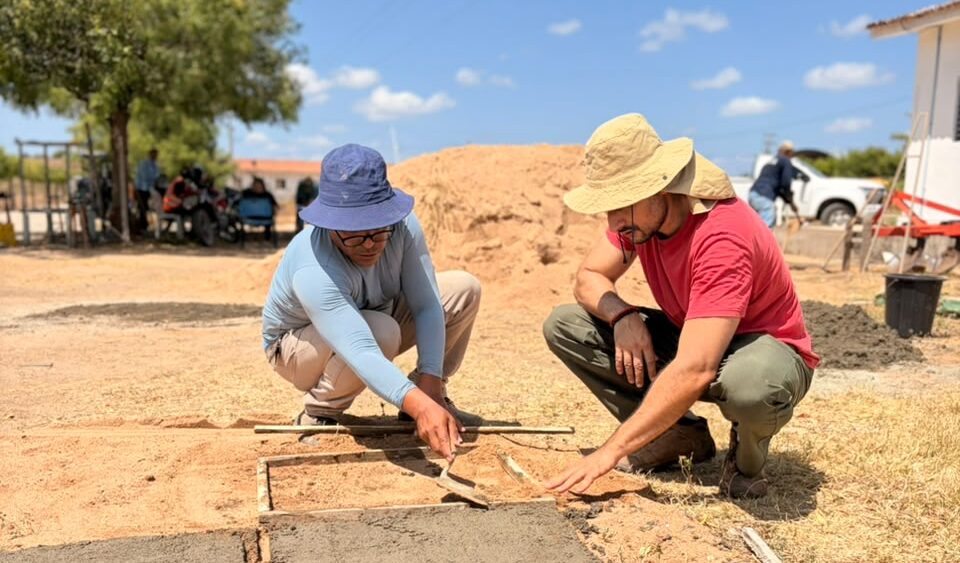
Under the guidance of researcher and professor Dr Luderlândio de Andrade Silva, the team took part in a practical training session on building a cistern alongside the UFCG team at the CCTA’s Experimental Farm.
The step-by-step method taught corresponds to a low-cost model, adaptable to various contexts and used in the Brazilian semi-arid region, where collecting and storing water is essential for food production and for ensuring families’ food and nutritional security.
“Just as the cistern has solved the problem of water scarcity in Brazil’s semi-arid regions, it can help people in other countries with similar circumstances to remain in rural areas. In my experience in African countries, this technology is very well suited to the context. The cistern is a low-cost technology that can be replicated and involves the whole community during construction, storing excellent-quality water for the dry months,” says Luderlândio.
The cistern built during the training course will remain for use by the university farm, which carries out research into soils, various crops (such as fruit and fodder crops) and agro-industrial systems.
The Regenerative School Meals project aims to transform schools into food production hubs linked to family farming. By mapping solutions developed in the Brazilian semi-arid region, the Centre of Excellence seeks to identify accessible technologies that can be adapted to other contexts with similar climates.
Productive Backyards
During the mission, the team also visited the Os Rufinos quilombo in Pombal, where the ‘Strengthening Productive Backyards’ project was developed. This project was created to ensure food security and a sustainable source of income, whilst strengthening family farming, women’s autonomy and the local economy.
The initiative was implemented by CCTA/UFCG and the Federal Institute of Paraíba (IFPB), with funding from the Government of Paraíba via the State Secretariat for Human Development (SEDH-PB).
Between late 2025 and mid-2025, the project established 50 productive kitchen gardens based on agroecological principles, managed by women from the Os Rufinos Quilombola Association.
The project has three main objectives: capacity-building, through workshops on agroecology, soil management, composting, management and marketing; setting up the vegetable gardens, with kits containing seeds and seedlings, hand tools and low-cost drip irrigation; and support for production, with ongoing technical support and two community markets to sell the produce.
As a result, families in the area have increased their production using organic and natural practices, ensuring a supply of healthy food for the community’s consumption and for sale to local shops and other Quilombola families.
Giudenia Silva de Souza, aged 30, was born and raised in the quilombo. Married to a quilombola from Os Rufinos and mother of two children, with the technical assistance and materials provided by the project she has been growing vegetables which she sells in town.
“It’s become an extra source of income for our family. We’re thinking of expanding our cultivation and, in the future, working solely on our own plots rather than on other people’s land,” she says.
Between January and April 2026, lecturers from UFCG carried out weekly monitoring of the project’s implementation amongst the women of the quilombo. In a survey to identify which crops they wanted to grow, the majority opted for fruit and vegetables, which have shorter production cycles.
“Within two weeks, we had lettuce, spring onions, parsley and coriander. When one neighbour saw another taking produce to the market and earning money, she asked to join in too. That’s when the programme really took off,” says Alfredina Santos, a lecturer and researcher at UFCG.
The quilombo now produces everything from bananas and cassava to cherry tomatoes and tamarind, as well as free-range chicken and honey. “Today we have women in the quilombo who have become entrepreneurs with their own business registration numbers. The community is not the same as it was eight months ago,” says Alfredina Santos.