


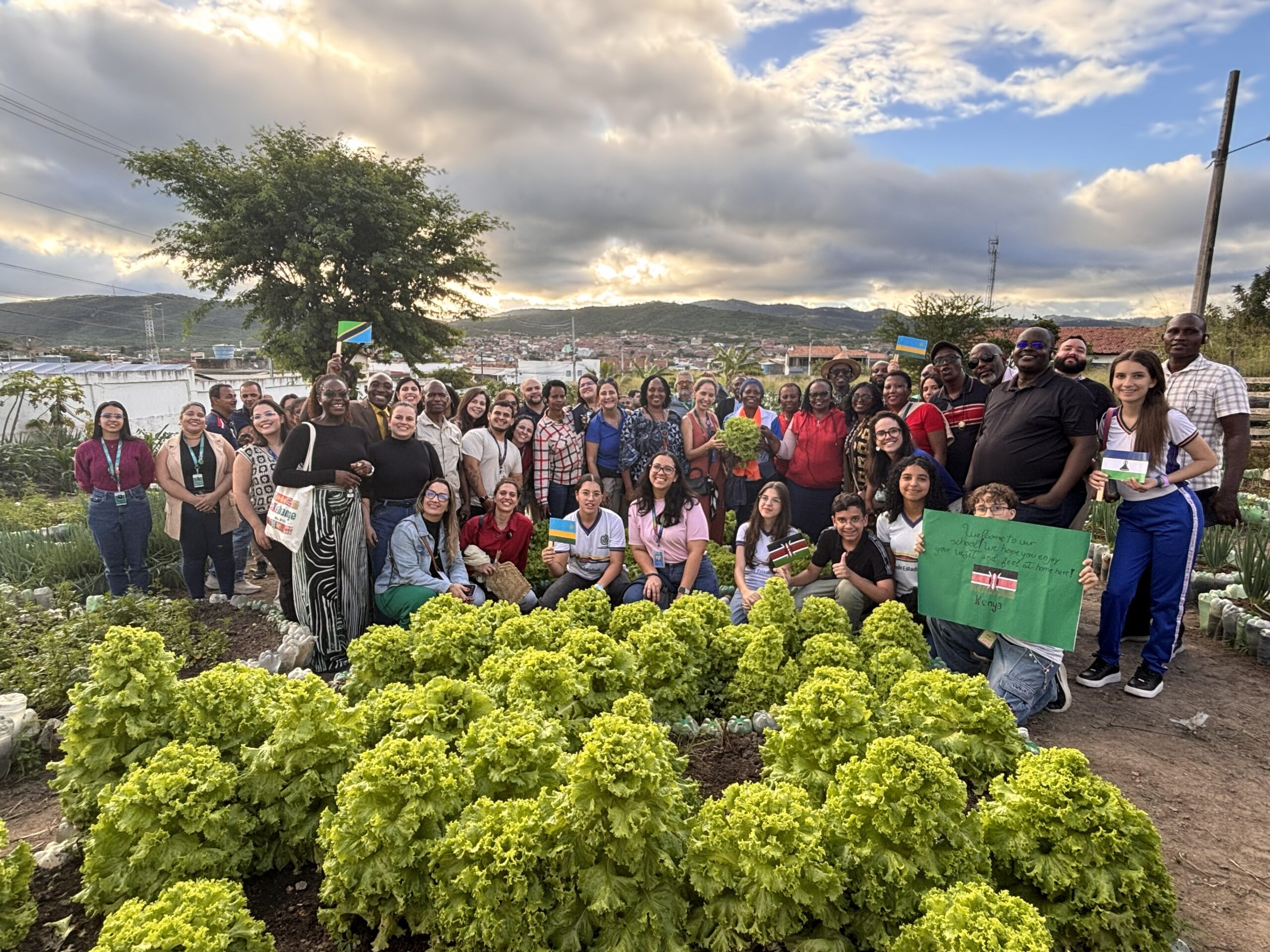
Delegations from five African countries (Kenya, Lesotho, Rwanda, Tanzania and Uganda) took part, between 8 and 12 June, in a study mission to Pernambuco to gain first-hand insight into Brazil’s school feeding experience, with a focus on the use of products from family farming and agroecology in the National School Feeding Programme (PNAE).
The programme took place in the cities of Recife and Caruaru and was organised by the World Food Programme’s (WFP) Centre of Excellence against Hunger, with support from the National Fund for Educational Development (FNDE), the Brazilian Cooperation Agency of the Ministry of Foreign Affairs (ABC/MRE) and the Pernambuco State Department of Education.
During the visit, the delegations were introduced to key facilities under the public school feeding policy. In Caruaru, they visited a municipal food distribution centre, where they observed the logistics of receiving and distributing products from family farms.
They also visited a secondary school to see the vegetable garden and observe how the school meals programme operates. The delegations witnessed everything from the creation of a menu tailored to local conditions to the preparation and distribution of meals, as well as the proper storage of food in the school kitchen.
“We learnt that we need to be intentional and have structure. The government here strongly supports the school feeding programme; it is a priority,” said Francis Atima, Director of the Ugandan Board of Educational Standards, on lessons learnt from Brazil.
The programme also included visits to initiatives linked to agroecology and local production, highlighting the role of smallholder farmers in supplying schools and promoting more sustainable and climate-resilient food systems.
For Vera Kwara, Head of Nutrition, HIV and School Feeding Programmes at the WFP in Tanzania, the visit to SERTA, a Civil Society Organisation of Public Interest (Oscip), provided many insights.
“The visit opened my eyes to how different agroecology techniques can be integrated to form such a beautiful system. I liked seeing how it is possible to adapt the techniques to different contexts; no matter what resources you have, it is possible to make it work,” she said.
In addition to the field activities, technical meetings were held in which African representatives presented their own experiences and challenges in school feeding.
The meetings fostered a dialogue on South-South cooperation, facilitating the exchange of knowledge on solutions tailored to different contexts and the strengthening of public policies aimed at food and nutritional security.
Internationally recognised, the Brazilian school feeding model integrates nutrition, education and public procurement from family farming, serving millions of students and acting as a benchmark for other countries seeking more sustainable food systems.