


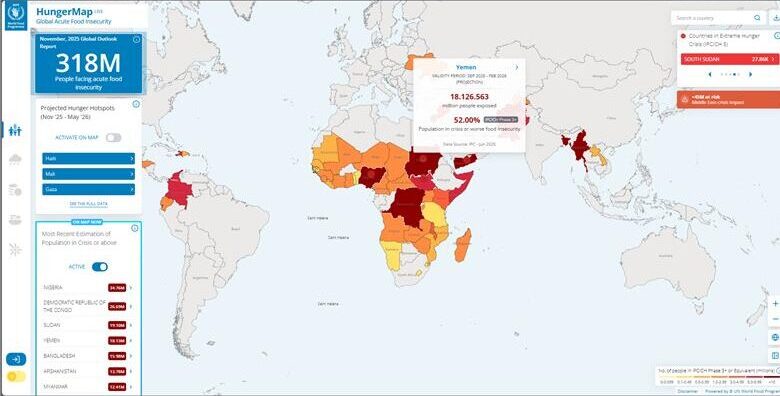
The United Nations World Food Programme (WFP) has launched the HungerMap Live platform, an interactive digital map that brings together global data on food security, advanced analytics and statistical forecasting models using artificial intelligence to support the fight against hunger in more than 50 countries.
Against a backdrop of rapidly rising food insecurity and constraints on humanitarian funding, the platform offers the most comprehensive and up-to-date view of hunger in the world’s most vulnerable countries.
The launch comes at a critical time. The number of people facing extreme hunger (IPC Phase 5 – Catastrophe) has risen from 85,000 in 2019 to 1.4 million in 2025, highlighting the urgency of evidence-based global early warning systems.
HungerMap Live enables the identification of trends, the anticipation of crises and the support of preventive actions, particularly in 16 countries classified by the WFP as “hunger hotspots”, where populations are already facing catastrophic levels of food insecurity.
The tool integrates information from the WFP’s extensive network, comprising over 300 specialist analysts, as well as data from partners such as the IPC (Integrated Food Security Phase Classification), government statistics, and climate, agricultural, economic and market indicators.
Studies show that anticipating crises can lead to significant savings: every dollar invested in the WFP’s preventive measures results in a minimum saving of seven dollars in emergency response.
In addition to mapping food insecurity, HungerMap Live includes a specific layer on micronutrient intake adequacy, linking access to food to the nutritional quality of diets. This feature helps identify populations at risk of ‘hidden hunger’, caused by deficiencies in essential vitamins and minerals.
The platform also highlights regional impacts, such as rising food prices in Latin America and the Caribbean, where the cost of a healthy diet is already the highest in the world. In countries heavily dependent on imports, such as Haiti, food inflation exacerbates existing vulnerabilities and increases the risk of food insecurity.
Centre of Excellence
The WFP Centre of Excellence against Hunger in Brazil has played a strategic role by engaging in technical cooperation with countries in the Global South, supporting governments in developing structural, sustainable solutions tailored to national realities to tackle hunger and malnutrition.
By promoting the exchange of experiences, public policies and innovative tools, the Centre contributes to strengthening national capacities and fostering coordinated responses to food insecurity.
For Daniel Balaban, director of the Centre of Excellence, initiatives such as HungerMap Live are essential for expanding international cooperation. “The fight against hunger cannot be pursued in isolation. Platforms such as HungerMap Live enable countries in the Global South to cooperate more strategically, basing their decisions on evidence and developing collective solutions that respect local contexts.